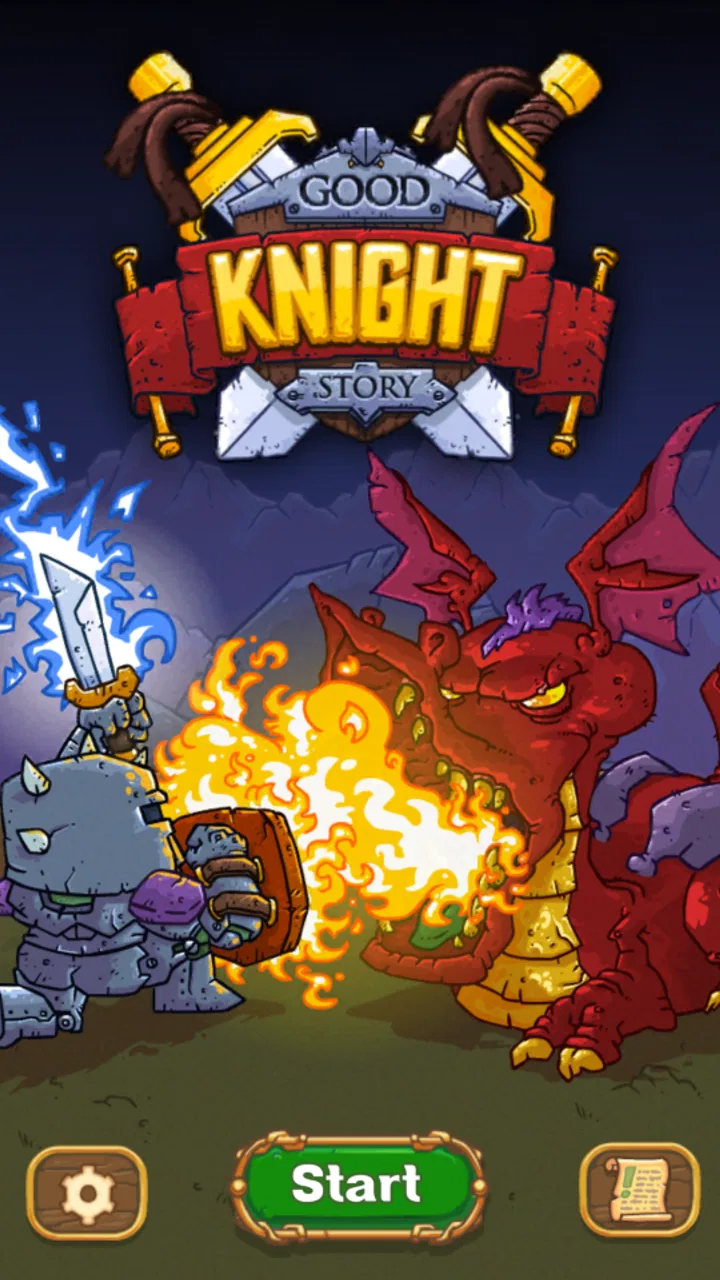
Good Knight Story
- 4.5
- Rating
- 1.00M
- Installs
- Free
- Price
 Analysis by App-foxy
I went into Good Knight Story expecting a light puzzle game with a medieval wrapper, and that is broadly what I found: a free board game from Turbo Chilli that mixes puzzle solving with monster battles. Its appeal is easy to understand within the first few sessions. You are not simply clearing shapes for their own sake; each move is tied to the small fantasy of helping an unlikely hero survive another dangerous situation.
That combination gives the game a more readable purpose than many casual board games. I always knew what I was working toward in a level, even when the immediate move was just about arranging a better match. The result is approachable, quick to understand, and well suited to short breaks. It is also more comfortable for players who want a guided adventure than for people looking for a deep competitive board game.
How the early puzzles establish the adventure
The opening stretch does a good job of making the basic loop feel useful rather than abstract. Puzzle actions and monster encounters belong to the same conversation, so the board feels like part of the hero’s problem. I found that framing important because it gave each early success a little more personality than a plain score increase.
You May Also Like

 Blood Strike: 2.5 Anniversary
Blood Strike’s Loadouts Turn Every Drop Into a Tactical Gamble
A close look at Blood Strike’s custom loadouts: how fast access to signature weapons reshapes its battle royale rhythm, rewards preparation, and narrows the gap between fights.

 Pandora - Music & Podcasts
Pandora’s Music Is Easy to Start, but Harder to Recover
Pandora’s strength is its low-effort path from a seed to a station. Its weak spot is how much confidence it asks you to place in connection, setup, and quiet recovery.

 8 Ball Pool
 Is Built on Rivalries, Rematches, and Routine
A close look at the rivalries, rematches, shared routines, and unanswered safety questions that turn a quick pool match into a persistent mobile community.

 Samsung Music
’s Quiet Strength Is Playing What You Already Own
Its reach comes less from spectacle than from dependable access to a personal library. That simplicity is both the app’s strongest retention engine and its ceiling.

 AccuWeather: Weather Radar
AccuWeather Review: A Quick, Clear Forecast for Everyday Decisions
For everyday plans, the best forecast is the one you can understand quickly. AccuWeather makes rain timing, radar, and local conditions easy to act on, with a few trade-offs.

 Hill Climb Racing
Why Hill Climb Racing Still Turns Crashes Into One More Run
A tiny car, a bumpy hill and one more upgrade: Hill Climb Racing keeps resurfacing because its simple chaos makes every near-miss feel personal.
More From Our News Desk



The early goals are also easy to grasp. I could focus on solving the immediate puzzle, watching the hero deal with the threat, and learning how the game expects me to think. That clarity matters on a phone, where a complicated rule set can feel tiring before the game has earned your attention.
What I liked most was the low barrier to entry. You do not need previous experience with board games, role-playing games, or match-style puzzles to understand the basic invitation. The medieval setting supplies the mood, while the puzzle board remains the practical center of play. For a friend who wants something casual but still wants a sense of adventure, this is an easy recommendation.
There is a trade-off, though. The story framing makes the first steps more inviting, but it does not turn the game into a full role-playing experience. If you are looking for extensive character decisions, a large world to explore, or a complex combat system, this is not the right place to look. Its strength is the compact connection between puzzle decisions and monster battles, not a sprawling fantasy campaign.
Small goals make short sessions work
I found the game particularly comfortable when I had only a few minutes available. A short session can still feel complete because the objective is local and understandable. I could play while waiting for an appointment, finish a small run during a commute break, or return to it in the evening without needing to reconstruct a complicated plot or remember a long chain of instructions.
That makes the game a better fit for interrupted play than for someone seeking a single uninterrupted challenge. It gives you a reason to begin, but it does not demand that you protect a large block of time. The board format supports that rhythm naturally, and the monster encounters help prevent the activity from feeling like an endless collection of disconnected puzzles.
One useful habit is to treat each move as part of the encounter rather than chasing the first attractive combination you see. I got better results when I paused briefly to consider what the board was offering and what the current threat required. That small change in attention made the puzzle feel less like tapping quickly and more like making a decision under pressure.
Progress is felt through context, not just numbers
The strongest progress signal is the way the adventure keeps giving puzzle victories a place in the hero’s journey. Even when the individual board is simple, the surrounding fantasy context gives completion a little more weight. I noticed that this helped me continue after an ordinary win, because the game made the next encounter feel like a natural step rather than a random restart.
This is where the title earns its identity. Without the hero and monster framing, it would be easier to compare it with any number of casual board games. With that framing, the same basic activity becomes a small story of survival. It is not dramatic storytelling, but it is enough to create forward motion for players who enjoy a light narrative coating around their puzzles.
Another practical strength is that the game communicates its purpose quickly. I did not need to spend much time deciding whether I was in a puzzle, a battle, or a separate management screen. That directness is valuable for younger players within the Teen rating as well as for adults who want to start playing without studying a manual.
The progress can feel less satisfying if you need a strong sense of long-term customization. Players who measure advancement through elaborate equipment choices, detailed builds, or strategic maps may find the journey comparatively narrow. The game’s progress is about moving through its puzzle-and-battle experience, not about giving you an enormous toolbox of ways to redesign the hero.
Learning the difficulty curve
The challenge works best when I approached it as a game of observation rather than speed. A board may present an obvious move, but the most useful move is not always the one that looks largest at first glance. I learned to scan for combinations that could improve the next turn, especially when the monster encounter made careless decisions more costly.
That creates a gentle shift in expectations. Early play is mainly about understanding the language of the board. Later, the same language asks for more patience and planning. The game remains accessible, but it becomes less satisfying to play on autopilot. For me, that was a healthy change because it gave the familiar puzzle structure room to develop instead of making every stage feel identical.
Still, the difficulty is unlikely to satisfy everyone equally. Casual players may appreciate the manageable entry point, while dedicated puzzle fans may eventually want more variety than the compact format provides. The right question is not whether it is the hardest board game available; it clearly is not. The better question is whether its challenge is enough to keep a player thinking during short, story-shaped sessions. For that purpose, it generally works.
When a level did not go well, I found it more useful to change my reading of the board than to repeat the same approach immediately. Look for the move that preserves future options, not merely the move that produces an attractive result now. This is a specific advantage of the game’s structure: the battle context encourages you to think about consequences, even though the controls remain simple.
Where the pacing keeps me playing
The pacing is built around a familiar casual-game tension. A successful puzzle gives me enough satisfaction to continue, while a difficult encounter creates a reason to try again. That rhythm is effective because it does not require the game to overwhelm me with features. The appeal comes from the steady alternation between understanding a board and seeing that understanding help the hero.
I also appreciated that the fantasy theme softens repetition. Board games often risk feeling interchangeable when the player performs similar actions repeatedly. Here, monster battles and the unlikely-hero premise give those actions a destination. The theme does not completely remove repetition, but it gives the repetition a clearer emotional shape.
There is a point where that same structure can become predictable. If you prefer constant novelty, a pure puzzle game with many different rule sets may hold your attention longer. If you prefer competitive play against real opponents, a traditional online board game would offer more uncertainty and social pressure. Good Knight Story is more controlled and personal: it is about handling the puzzle in front of you, not outsmarting another person.
That distinction helped me decide when to recommend it. I would suggest it to someone who wants a self-contained fantasy distraction, especially if they like board puzzles but do not want a serious strategy commitment. I would skip it for a player whose main goal is multiplayer competition, deep tactical planning, or a large role-playing progression system.
Free access and the question of spending
The game is free to download, which makes it easy to try without making a commitment first. That is useful for this kind of casual title because the central question is personal: will the puzzle-and-monster combination keep you interested after the novelty of the setting wears off?
There are in-app purchases ranging from $0.99 to $29.99 per item. I would keep that in mind before handing the game to a child or letting someone play on a shared device. The Teen content rating also makes it worth checking whether the tone and purchase options suit the person using it.
My advice is to decide in advance whether you want to spend anything. The game is easier to enjoy when a purchase is treated as an optional convenience rather than as part of the basic expectation. If you are uncomfortable with in-app purchase pressure in casual games, you may prefer a paid board game with a single upfront cost, even if that means giving up the fantasy setting and this particular puzzle structure.
The retention design works because it combines three modest pressures: the desire to solve the current board, the curiosity about the next monster encounter, and the satisfaction of seeing the hero continue. None of these needs to be enormous on its own. Together, they are enough to bring me back for another short session, particularly when I had nearly solved a difficult situation and wanted to test a different approach.
Device fit, age, and practical expectations
Good Knight Story supports Android 7.0 and later, so it is aimed at a broad range of Android devices rather than only the newest phones. I would still judge the experience by the actual phone in use, especially if the device is older or shared with a child, but the operating-system requirement is not especially demanding for modern Android users.
The game was released on June 8, 2016, and its current version is 1.0.12. That history explains part of its straightforward identity. It feels like a focused casual game rather than a constantly expanding platform that asks you to follow a large live-service ecosystem. Players who like established, self-contained mobile experiences may find that reassuring; players who expect frequent reinvention may want something newer and more elaborate.
Its audience size suggests that the concept has traveled well. The game has more than one million installs, an average rating of 4.5 from around 273 thousand ratings, and roughly 16 thousand written reviews. Those figures do not replace personal taste, but they do indicate that the puzzle-adventure blend has found a substantial audience.
I would describe the Teen rating as another reason to consider the intended tone before recommending it to a younger child. The premise involves battles with monsters, and the game is not presented as a preschool experience. For an older child, teenager, or adult who enjoys playful fantasy conflict, the setting should be easier to place. For very young players, a gentler board game would be a safer starting point.
How it compares with familiar alternatives
Compared with a traditional board-game adaptation, this title is less concerned with recreating a tabletop rule set and more interested in using the board as a route through a fantasy adventure. That makes it quicker to pick up, but it may feel less substantial to someone who wants a long strategic session with many interacting rules.
Compared with a standard match-style puzzle, the hero and monster encounters give the actions more context. The benefit is stronger motivation during a short session. The cost is that players who only want a clean score-chasing experience may find the adventure layer unnecessary. A pure puzzle alternative can be better if you want minimal distractions and direct competition with your own best performance.
Compared with a conventional role-playing game, Good Knight Story is much more compact. You are not choosing it for a huge world or detailed character planning. You are choosing it because a few puzzle decisions can feel like a small piece of an adventure. That is a narrower promise, but it is also why the game fits neatly into spare moments.
One non-obvious strength is how well the theme helps with re-entry. When I returned after a break, I did not need to remember a complicated control scheme. The board and the immediate monster problem gave me enough direction to resume quickly. That is a real advantage over deeper strategy games, where a long pause can make the next session feel like homework.
One limitation is the opposite side of that simplicity: if you want a game that rewards studying a large system over many weeks, this may not give you enough depth. Its best use is as a focused, approachable puzzle adventure, not as the only game in a serious strategy player’s library.
My progression verdict
After spending time with it, I see the progression as a steady invitation rather than a grand system of mastery. The early goals are clear, the puzzle-and-battle connection gives victories meaning, and the difficulty encourages more careful board reading without abandoning casual accessibility. The pacing is strongest when I want a short session with a little narrative flavor.
The game sustains play through understandable forward motion: solve what is in front of you, help the hero through the encounter, and decide whether the next challenge is worth another attempt. That loop is modest, but it is coherent. It does not need exaggerated promises to work.
My honest recommendation is to try it if you want a free fantasy board game for brief, self-contained sessions. I would especially point it toward players who enjoy puzzle decisions but like having a hero and monsters give those decisions a purpose. I would steer competitive board-game fans, deep role-playing enthusiasts, and anyone who dislikes optional purchase systems toward different alternatives.
For me, the lasting appeal is not complexity; it is the clean fit between the board and the adventure. Turbo Chilli keeps the experience focused enough for casual play while giving each encounter a little more personality than a bare puzzle grid. That makes Good Knight Story an easy game to keep installed for spare moments, provided you understand that its charm comes from compact progression and approachable challenge rather than endless strategic depth.
FAQs for Good Knight Story
01What is Good Knight Story?
Good Knight Story is a casual puzzle RPG that combines match-three gameplay with a humorous fantasy adventure. You guide a knight through dangerous encounters by matching tiles on the board, dealing damage, collecting useful items, and overcoming enemies. The game is designed for short sessions, making it suitable for players who enjoy simple controls, light strategy, and story-driven mobile games.
02How does the gameplay work in Good Knight Story?
The main gameplay revolves around matching three or more identical symbols to create attacks, shields, healing effects, or other bonuses. Each move can influence the battle, so choosing the right combination is important rather than matching tiles randomly. As you progress, enemies become more challenging and you need to manage your moves carefully while using the board to support your knight.
03Is Good Knight Story free to download and play?
Good Knight Story can generally be downloaded and played without an upfront purchase, although the exact availability and monetization may depend on the platform and region. Like many free mobile games, it may include optional in-app purchases, advertisements, or other systems that can speed up progress. It is advisable to review the store listing before downloading, especially if children use the device.
04Does Good Knight Story require an internet connection?
Some parts of Good Knight Story may be playable offline, which is convenient when you are traveling or have limited connectivity. However, an internet connection can still be required for downloading the game, displaying advertisements, synchronizing progress, receiving updates, or accessing platform-related features. Because requirements can change with updates, check the current Google Play or App Store description before relying on offline play.
05Is Good Knight Story suitable for children and casual players?
Good Knight Story is generally approachable for casual players because its controls are straightforward and the match-three format is easy to understand. Its fantasy battles and cartoon-style presentation make it less intimidating than many traditional RPGs. Nevertheless, parents should check the age rating, advertising, in-app purchase options, and any data-collection information on the relevant app store before allowing younger players to install it.
Pros
- Simple controls make it easy to start playing quickly.
- Short levels fit well into quick gaming sessions.
- Colorful visuals give the adventure a cheerful style.
- Puzzle battles offer satisfying moments of strategic planning.
- The lighthearted humor keeps the campaign entertaining.
Cons
- Later stages can feel repetitive after extended play.
- Some difficulty spikes may frustrate less experienced players.
- Progress can depend heavily on random tile combinations.
- The story may feel too brief for players wanting more depth.
- Limited variety may reduce long-term replay value.

Good Knight Story
Gallery